Abstract
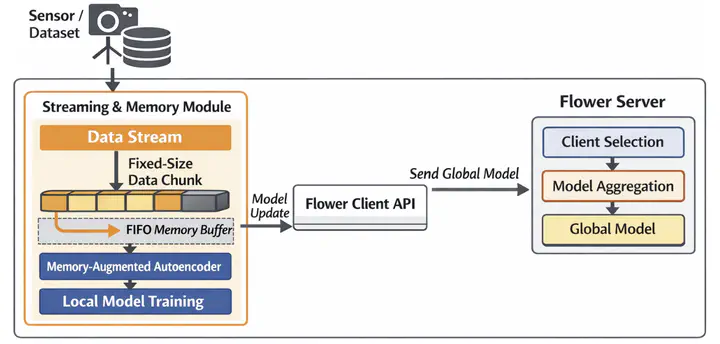
Internet of Things (IoT) / Edge devices produce continuous data streams while operating under limited storage and communication constraints. When performing Machine Learning related tasks, such constraints are particularly restrictive in various settings where data coming from IoT devices are non-IID, and may change over time. This work introduces anomaly detection in streaming Federated Learning (FL) environments with resource-constrained devices. We propose a framework that integrates FL with a memory-Augmented Autoencoder, enabling each client to learn from streaming data while mitigating the effects of limited local storage. To improve global learning, the framework includes client selection strategies that prioritize clients based on information collected during training. Our experimental evaluation explores realistic scenarios covering a wide range of data overflow and streaming conditions, showing that the proposed approach maintains stable performance compared to baseline FL approaches that rely on regular autoencoders or omit either streaming or storage constraints.

Raafat Osman
Software Engineer

Zahraa El Attar
Postdoc Researcher

Nikolaos Papadakis
PhD Student
Georgios Bouloukakis
Assistant Professor
My research interests include middleware, internet of things, distributed systems.