Architectural Foundations for Collaborative Machine Learning in Federated Data Spaces
Abstract
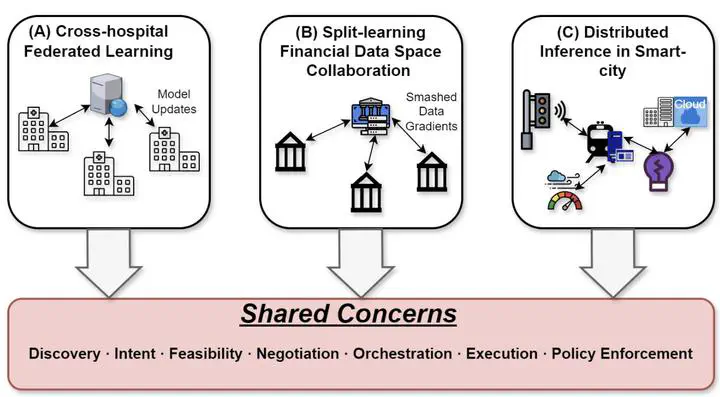
Data spaces enable organisations to expose data and services without relinquishing control, yet running Machine Learning (ML) workflows across organisations remains largely ad hoc. Techniques such as Federated Learning and split learning allow model optimisation without centralising data, while data-space infrastructures support sovereign data sharing. What is missing is the architectural glue that turns these ingredients into dependable collaborative ML workflows. This paper proposes a reference software architecture for collaborative ML on federated data spaces. The architecture organises coordination into six layers implemented as coordination services operating over a distributed knowledge base, making explicit how collaborations are established, adapted, and governed across autonomous domains. We evaluate the architecture through scenario-based analysis and a cross-hospital FL prototype. Experiments on three benchmark datasets with heterogeneous, non-IID clients show improved accuracy over isolated training with comparable training times, indicating that collaborative ML in federated data spaces can be effectively addressed as a software-architecture problem.

Nikolaos Papadakis
PhD Student
Georgios Bouloukakis
Assistant Professor
My research interests include middleware, internet of things, distributed systems.